
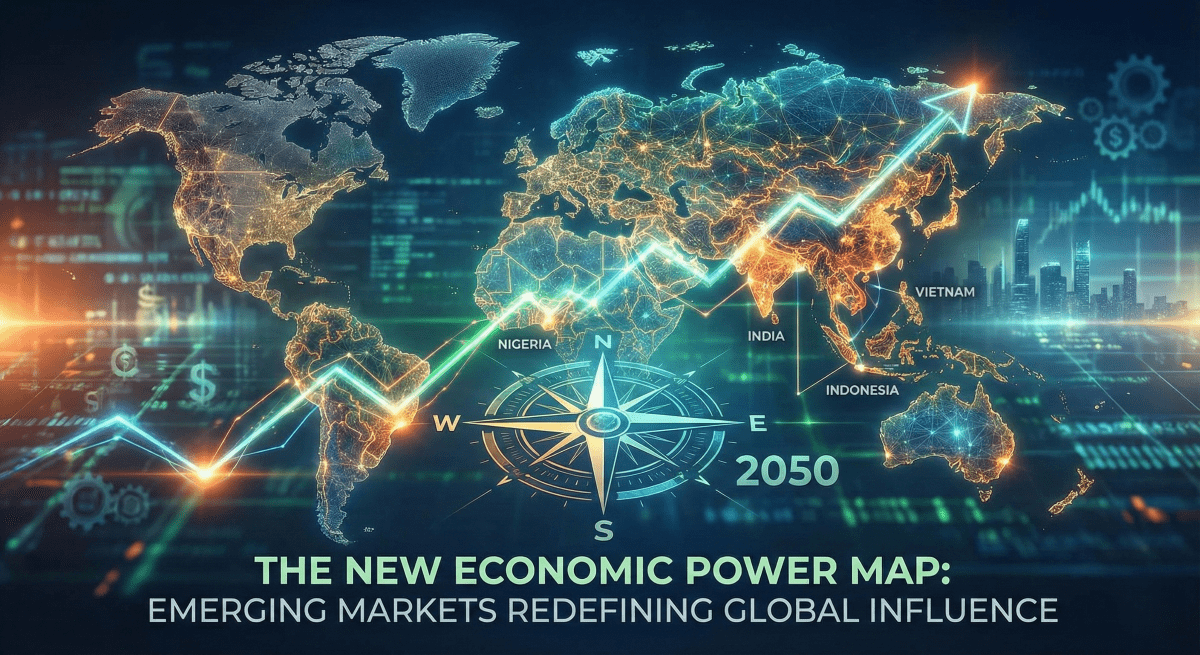
How Emerging Markets Are Redefining Global Influence
The global economic landscape is undergoing a seismic shift. While the 20th century was defined by Western economic dominance, the 21st century is witnessing the rise of a new economic order—one where emerging markets are not just participating in the global economy, but actively reshaping it.
Countries like India, Indonesia, Vietnam, and Nigeria are no longer merely destinations for outsourcing or commodity extraction. They are becoming innovation hubs, consumer powerhouses, and strategic players in global trade networks. By 2050, these nations will have fundamentally altered the geography of economic power, creating new centers of influence that will rival—and in some cases surpass—traditional economic giants.
The Demographic Dividend: Youth as Economic Fuel
At the heart of this transformation lies a powerful demographic reality. While developed nations grapple with aging populations, emerging markets are experiencing a youth boom that will shape their economic trajectory for decades.
India stands at the forefront of this demographic shift. With a median age of just 28 years and a population that recently surpassed China’s, India now hosts the world’s largest workforce. By 2050, its working-age population will exceed 1 billion people. This vast human capital base drives consumption, innovation, and entrepreneurial activity.
Indonesia follows a similar pattern. With over 270 million people and a median age of 30, it is Southeast Asia’s demographic giant and is projected to become the world’s fourth-largest economy by mid-century.
Vietnam, with nearly 100 million people and a young demographic profile, has moved rapidly from an agricultural past to a key node in global manufacturing.
Nigeria represents Africa’s demographic future. Already the continent’s most populous nation, its population is expected to almost double by 2050. If Nigeria can harness this growth through education and infrastructure investment, it could become one of the world’s most significant economic forces.
The New Trade Architecture: Beyond Traditional Alliances
The rise of these economies is reshaping global trade. Traditional supply chains—raw materials flowing to Western factories and finished products returning to developing nations—are giving way to diversified, decentralized networks.
India has become central to supply chain diversification, attracting investment through “Make in India” initiatives and expanding its role as a global services exporter.
Vietnam’s integration into global value chains has been rapid, strengthened by a network of free trade agreements and major investments from global technology companies.
Indonesia is leveraging its natural resources more strategically by emphasizing value-added processing, particularly in nickel-based industries tied to electric vehicles.
Nigeria, though facing structural challenges, remains the economic backbone of West Africa and is positioned to benefit from the African Continental Free Trade Area.
The Rise of South–South Trade
South–South commerce continues to expand rapidly. China remains a major catalyst, but other emerging markets are pursuing their own trade and investment relationships. These expanding networks strengthen economic autonomy by reducing reliance on Western markets.
Innovation Ecosystems: From Copiers to Creators
Emerging markets are increasingly contributing to global innovation.
India now hosts more than 100 unicorns across sectors.
Indonesia’s digital economy is expanding through super-app ecosystems.
Vietnam is moving toward higher-value manufacturing and R&D.
Nigeria’s tech scene is pioneering fintech and logistics solutions for the African continent.
The Infrastructure Imperative
Large-scale infrastructure development underpins these transformations.
India is investing heavily in transport, digital connectivity, and renewable energy.
Indonesia is undertaking major connectivity projects across its archipelago and planning a new capital city.
Vietnam continues to expand industrial zones and transportation networks.
Nigeria faces significant gaps but has the potential for exceptional productivity gains from targeted infrastructure improvements.
The Middle Class Explosion: Consumption as Growth Engine
The expansion of middle classes across emerging markets is reshaping global consumption patterns.
By 2050, Asia is expected to account for more than half of global middle-class consumption, led by India. Indonesia’s middle class already exceeds 50 million, Vietnam is experiencing rapid income growth, and Nigeria is seeing the rise of a consumer base concentrated in urban centers.
The Green Transition: Opportunity or Obstacle?
Emerging economies face a complex balance between development needs and decarbonization commitments.
India is pushing forward with ambitious renewable energy targets.
Indonesia is both challenged and positioned to benefit from the global shift to electric vehicles.
Vietnam is expanding solar and wind capacity to meet market requirements.
Nigeria and other African nations emphasize the importance of a “just transition,” while holding significant renewable potential.
Financial Markets and Capital Flows
Capital markets in emerging economies are becoming deeper and more globally integrated.
India’s markets now exceed $5 trillion in capitalization.
Indonesia is attracting international investors through expanded financial infrastructure.
Vietnam is progressing toward inclusion in major emerging market indices.
Nigeria’s fintech ecosystem is creating new digital financial systems across the continent.
Geopolitical Implications: Economic Power as Strategic Influence
Economic strength translates into geopolitical influence.
India is asserting itself as a leader of the Global South.
Indonesia is becoming more influential within ASEAN.
Vietnam balances relations with major powers while deepening global economic ties.
Nigeria’s decisions often carry continental weight.
Challenges and Vulnerabilities
Despite strong growth trajectories, emerging markets face persistent challenges: governance constraints, infrastructure gaps, education and skills shortages, political instability, climate risks, and rising inequality. These factors could slow or disrupt their economic ascent.
The 2050 Vision: A Multipolar Economic Order
By 2050, the global economic landscape will be significantly more multipolar.
India could become the world’s second-largest economy.
Indonesia may rank among the top five.
Vietnam could grow tenfold, becoming a major regional power.
Nigeria’s future holds enormous potential if governance and structural reforms succeed.
Implications for Business and Investment
Global businesses will need to adapt by developing local strategies, diversifying supply chains, establishing R&D centers within emerging markets, and integrating sustainability into operations.
The West’s Response: Adaptation or Resistance?
Developed economies are seeking to maintain competitiveness through innovation and policy reforms, while also showing protectionist tendencies. The most constructive outcomes will emerge from cooperation rather than fragmentation.
A More Complex, Competitive, and Prosperous World
The rise of emerging market power is expanding global prosperity and shifting the world toward a more diverse and competitive economic system. Successfully navigating this transition requires strong institutions, sound policy, human capital investment, and global cooperation. By 2050, today’s emerging markets will sit at the center of global economic influence. The question is not whether this shift will occur, but how quickly and how smoothly the world can adapt to it.