
How Global Brands Accelerate Growth Through Strategic Procurement
Private label is no longer a fallback option for budget-conscious shoppers. It has become a strategic growth engine for retailers worldwide, a competitive weapon against national brands, and a vehicle for building customer loyalty. The numbers tell a compelling story: private label sales in the United States reached $270-280 billion in 2025, growing 3.7% year-over-year while national brands managed only 1.1% growth. Market share hit all-time highs of 21.2% in dollars and 23.2% in units.
Globally, the private label market stood at $915 billion in 2024 and is projected to reach $1.6 trillion by 2034, growing at 5.9% annually. This isn’t a temporary surge driven by inflation—it’s a structural shift in how consumers shop and how retailers compete.
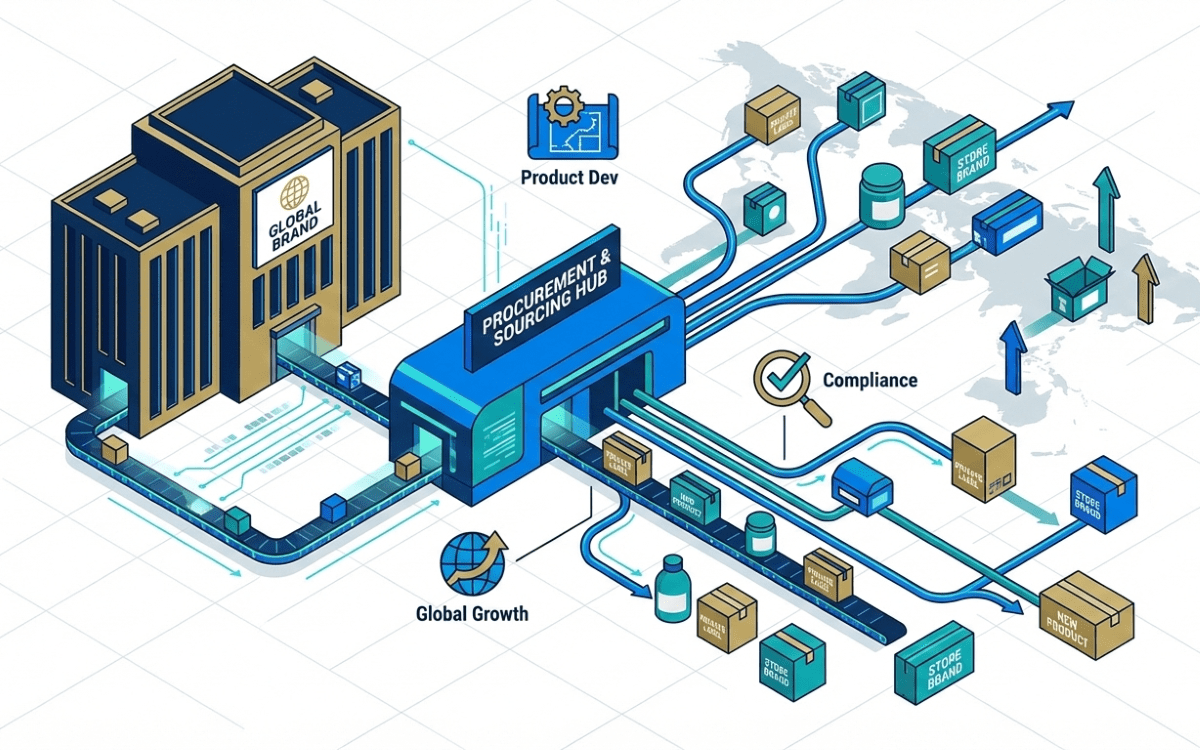
Behind this growth lies a critical but often underappreciated function: professional sourcing and procurement. The retailers winning in private label aren’t simply slapping their logos on generic products. They’re building sophisticated supply chains, developing differentiated products, and ensuring compliance across complex regulatory landscapes. Strategic procurement has become the difference between mediocre private label programs and those that drive meaningful revenue and margin expansion.
The Private Label Boom: More Than Just Inflation
Private labels initially surged during the pandemic when supply chain disruptions created stockouts, pushing shoppers to try store brands. Inflation accelerated the trend as consumers traded down to lower-priced alternatives. By 2025, private label products remained 20-30% cheaper than national brands despite their own 8% price increases.
But price alone doesn’t explain the sustained momentum. Consumer attitudes have shifted. Nearly 60% of Americans report buying more private label products, with 68% citing affordability as the primary driver. However, 30% now choose private labels based on perceived quality—a fundamental change from the “cheap alternative” perception of decades past.
Demographics matter too. Gen Z leads adoption, with 64% consistently purchasing private label products. Younger consumers view store brands not as compromises but as smart choices that deliver value without sacrificing quality. As this generation gains purchasing power, private label’s structural advantages solidify.
Regional variations remain striking. In European markets, the Netherlands and Spain lead the way, with private labels commanding 55% and 51% of grocery sales, respectively. Other mature markets like Germany (42%) and the UK (37%) follow closely behind. Meanwhile, the U.S. has reached a significant milestone; for the first half of 2025, store brand market share hit an all-time high, officially breaching the 21% threshold in dollar sales and 23% in units, rapidly narrowing the historical gap with Europe.
Why Retailers Are Doubling Down
Private labels deliver strategic benefits that national brands cannot match. Margin advantages are substantial—typically 25-35% gross margins compared to 15-20% for national brands. Retailers control pricing, placement, and promotion without negotiating with brand manufacturers. Shelf space is guaranteed.
Differentiation drives loyalty. Exclusive products that shoppers can’t find elsewhere create reasons to visit specific stores. Target’s Good & Gather, Costco’s Kirkland, and Trader Joe’s entire product lineup exemplify how private labels become destination draws.
Control over product development allows rapid response to consumer trends. While national brands require 18-24 months to bring products to market, retailers with strong sourcing teams can launch in 6-9 months. This agility is particularly valuable in categories like organic foods, plant-based proteins, and sustainable packaging where consumer preferences shift quickly.
The strategic calculation is clear: as private label penetration increases, retailer power grows relative to national brands. This explains why major chains are investing hundreds of millions in private label development, treating it as core business strategy rather than a side project.
The Critical Role of Professional Sourcing Teams
The complexity of private label sourcing is vastly underestimated. Retailers must identify capable manufacturers, negotiate pricing and terms, manage quality across multiple suppliers, ensure regulatory compliance, coordinate logistics, and do all this while hitting aggressive cost targets.
Professional sourcing teams solve these challenges systematically. Their first function is supplier identification and vetting. Finding manufacturers isn’t difficult—finding reliable ones that meet quality standards, capacity requirements, and compliance expectations is. Experienced sourcing professionals maintain networks of pre-qualified suppliers across geographies and categories, reducing risk and accelerating product launches.
Negotiation expertise matters. Beyond unit cost, sourcing teams structure agreements covering minimum order quantities, payment terms, quality specifications, delivery schedules, and liability protections. These details determine program profitability and operational feasibility.
Supplier diversification is critical. Relying on single manufacturers creates vulnerability to disruptions, quality failures, or capacity constraints. Strategic sourcing teams build multi-supplier networks that provide redundancy while maintaining cost efficiency through competitive dynamics.
Product Development: From Concept to Shelf
Private label product development follows a structured process that professional procurement teams coordinate. It begins with market research—identifying gaps in existing offerings, emerging consumer trends, and whitespace opportunities where private labels can differentiate.
Formulation development requires technical expertise. For food products, this means working with food scientists to optimize taste, texture, nutritional profiles, and shelf stability. For household goods, it involves chemical formulation, efficacy testing, and packaging compatibility. Cosmetics demand dermatological testing and allergen management.
Sourcing teams connect retailers with manufacturers possessing the required technical capabilities. This isn’t commodity purchasing—it’s collaborative product development requiring deep category knowledge and strong manufacturer relationships.
Packaging represents another layer of complexity. Private label packaging must balance cost efficiency with brand positioning. Premium lines demand design quality rivaling national brands. Value lines prioritize functional simplicity. Sourcing teams coordinate with packaging suppliers, graphic designers, and regulatory experts to ensure labels meet legal requirements while supporting brand strategy.
Prototype development and testing validate concepts before full-scale production. Professional sourcing operations build testing phases into timelines, managing sample logistics, coordinating sensory evaluations, and incorporating feedback into specifications.
Compliance: The Non-Negotiable Foundation
Regulatory compliance is where private label programs succeed or fail. Retailers bear full liability for products sold under their brands, making compliance management mission-critical.
Food safety regulations vary by market. US products must comply with FDA requirements, USDA standards for meat and poultry, and state-level regulations. European Union requirements include detailed ingredient declarations, allergen labeling, and nutritional information formatted to EU standards. Export markets add layers of country-specific requirements.
Professional sourcing teams ensure manufacturers maintain appropriate certifications. GMP (Good Manufacturing Practices) certification is baseline for food and supplements. Organic claims require USDA Organic or equivalent certification. Kosher and Halal certifications are essential for products targeting those markets.
Quality management systems provide audit trails demonstrating compliance. ISO 22000 for food safety management, HACCP (Hazard Analysis Critical Control Points) for food processing, and BRC (British Retail Consortium) standards for supplier verification are industry expectations. Sourcing teams verify these certifications exist and remain current, conduct periodic factory audits, and maintain documentation proving due diligence.
Product testing protocols vary by category. Food products require microbiological testing, pesticide residue analysis, and nutritional verification. Cosmetics need stability testing, microbial challenge testing, and safety assessments. Household chemicals require toxicology evaluations and environmental impact assessments.
Third-party testing labs provide independent verification. Experienced sourcing teams establish relationships with accredited laboratories, structure testing protocols matching product risks, and manage the documentation required for regulatory compliance and customer claims substantiation.
Logistics and Supply Chain Optimization
Getting products from manufacturers to stores involves coordinating international shipping, customs clearance, warehousing, and distribution. Private label programs compound this complexity by managing multiple product lines from diverse suppliers.
Lead time management determines inventory levels and stockout risk. Sourcing teams work backward from shelf availability requirements to establish production schedules, shipping timelines, and buffer stock levels. This requires understanding manufacturing lead times, ocean freight schedules, port congestion patterns, and seasonal demand fluctuations.
Customs compliance adds another dimension. Import documentation—commercial invoices, packing lists, bills of lading, certificates of origin—must be accurate and complete. Tariff classification determines duty rates. Non-compliance creates delays, fines, and shipment rejections. Professional sourcing operations either maintain internal customs expertise or partner with customs brokers who manage these details.
Consolidation strategies reduce freight costs. Rather than shipping individual product lines separately, sophisticated sourcing teams coordinate production timing to consolidate multiple SKUs into container loads, optimizing freight efficiency while maintaining inventory flow.
Warehouse management for private label requires flexibility to accommodate varying order patterns, promotional spikes, and new product introductions. Sourcing teams coordinate with operations and logistics partners to ensure sufficient capacity exists while avoiding excess inventory costs.
Premiumization: Moving Beyond Value
The most sophisticated private label programs aren’t competing only on price—they’re premiumizing. Retailers increasingly offer tiered private label portfolios: value lines competing on affordability, mainstream lines matching national brand quality at lower prices, and premium lines offering superior quality or unique attributes.
This premiumization requires different sourcing approaches. Premium private labels demand manufacturers with advanced capabilities, premium ingredient sourcing, sophisticated packaging, and quality standards exceeding mainstream products. This increases costs but supports higher pricing and margins while building brand prestige.
Organic, non-GMO, sustainably sourced, and clean-label products represent major growth areas. These segments require sourcing teams with expertise in specialty supply chains, certification management, and ingredient traceability.
Limited-edition products and seasonal offerings create excitement and urgency. Sourcing teams must balance the complexity of small production runs against the marketing value of exclusive products that generate consumer engagement.
The Path Forward
Private label expansion continues accelerating. Retailers see it as strategic necessity, consumers embrace it as smart shopping, and manufacturers recognize it as stable business. This convergence ensures sustained growth.
For retailers and brands, success requires treating private label as core business, not a peripheral activity. This means investing in professional sourcing teams with category expertise, manufacturer networks, and compliance capabilities. It means building supplier relationships based on quality and capability, not just cost. And it means integrating product development, sourcing, compliance, and logistics into cohesive programs.
The competitive advantage in private label increasingly comes not from the decision to pursue it—most retailers already have—but from execution excellence. Those with sophisticated sourcing operations, compliance rigor, and product development capabilities will capture disproportionate growth. Those relying on ad-hoc sourcing will struggle with quality problems, compliance failures, and margin erosion.
Private label’s trajectory is clear. The question is which players will master the sourcing and operational complexity required to win.